


There are 6 basic types of hydroponic systems; Wick, Water Culture, Ebb and Flow (Flood & Drain), Drip (recovery or non-recovery), N.F.T. (Nutrient Film Technique) and Aeroponic. There are hundreds of variations on these basic types of systems, but all hydroponic methods are a variation (or combination) of these six. Scroll down this page (or click on the system names) to see drawings and a description of each type of hydroponic system.
WICK SYSTEM
The Wick system is by far the simplest type of hydroponic system. This is a passive system, which means there are no moving parts. The nutrient solution is drawn into the growing medium from the reservoir with a wick. Free plans for a simple wick system are available (click here for plans).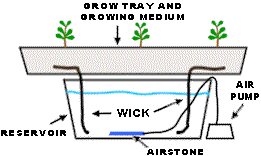
This system can use a variety of growing medium. Perlite, Vermiculite, Pro-Mix and Coconut Fiber are among the most popular.
The biggest draw back of this system is that plants that are large or use large amounts of water may use up the nutrient solution faster than the wick(s) can supply it.
WATER CULTURE
 The water culture system is the simplest of all active hydroponic systems. The platform that holds the plants is usually made of Styrofoam and floats directly on the nutrient solution. An air pump supplies air to the air stone that bubbles the nutrient solution and supplies oxygen to the roots of the plants.
Water culture is the system of choice for growing leaf lettuce, which are fast growing water loving plants, making them an ideal choice for this type of hydroponic system. Very few plants other than lettuce will do well in this type of system.
This type of hydroponic system is great for the classroom and is popular with teachers. A very inexpensive system can be made out of an old aquarium or other water tight container. We have free plans and instructions for a simply water culture system (click here for free plans).
The biggest draw back of this kind of system is that it doesn’t work well with large plants or with long-term plants.
EBB & FLOW – (FLOOD AND DRAIN)
The Ebb and Flow system works by temporarily flooding the grow tray with nutrient solution and then draining the solution back into the reservoir. This action is normally done with a submerged pump that is connected to a timer.
When the timer turns the pump on nutrient solution is pumped into the grow tray. When the timer shuts the pump off the nutrient solution flows back into the reservoir. The Timer is set to come on several times a day, depending on the size and type of plants, temperature and humidity and the type of growing medium used.
The Ebb & Flow is a versatile system that can be used with a variety of growing mediums. The entire grow tray can be filled with Grow Rocks, gravel or granular Rockwool. Many people like to use individual pots filled with growing medium, this makes it easier to move plants around or even move them in or out of the system. The main disadvantage of this type of system is that with some types of growing medium (Gravel, Growrocks, Perlite), there is a vulnerability to power outages as well as pump and timer failures. The roots can dry out quickly when the watering cycles are interrupted. This problem can be relieved somewhat by using growing media that retains more water (Rockwool, Vermiculite, coconut fiber or a good soiless mix like Pro-mix or Faffard’s).
DRIP SYSTEMS
RECOVERY / NON-RECOVERY
 Drip systems are probably the most widely used type of hydroponic system in the world. Operation is simple, a timer controls a submersed pump. The timer turns the pump on and nutrient solution is dripped onto the base of each plant by a small drip line. In a Recovery Drip System the excess nutrient solution that runs off is collected back in the reservoir for re-use. The Non-Recovery System does not collect the run off.
A recovery system uses nutrient solution a bit more efficiently, as excess solution is reused, this also allows for the use of a more inexpensive timer because a recovery system doesn’t require precise control of the watering cycles. The non-recovery system needs to have a more precise timer so that watering cycles can be adjusted to insure that the plants get enough nutrient solution and the runoff is kept to a minimum.
The non-recovery system requires less maintenance due to the fact that the excess nutrient solution isn’t recycled back into the reservoir, so the nutrient strength and pH of the reservoir will not vary. This means that you can fill the reservoir with pH adjusted nutrient solution and then forget it until you need to mix more. A recovery system can have large shifts in the pH and nutrient strength levels that require periodic checking and adjusting.
N.F.T.
(Nutrient Film Technique)
This is the kind of hydroponic system most people think of when they think about hydroponics. N.F.T. systems have a constant flow of nutrient solution so no timer required for the submersible pump. The nutrient solution is pumped into the growing tray (usually a tube) and flows over the roots of the plants, and then drains back into the reservoir.
There is usually no growing medium used other than air, which saves the expense of replacing the growing medium after every crop. Normally the plant is supported in a small plastic basket with the roots dangling into the nutrient solution.
N.F.T. systems are very susceptible to power outages and pump failures. The roots dry out very rapidly when the flow of nutrient solution is interrupted.
AEROPONIC
 The aeroponic system is probably the most high-tech type of hydroponic gardening. Like the N.F.T. system above the growing medium is primarily air. The roots hang in the air and are misted with nutrient solution. The mistings are usually done every few minutes. Because the roots are exposed to the air like the N.F.T. system, the roots will dry out rapidly if the misting cycles are interrupted.
A timer controls the nutrient pump much like other types of hydroponic systems, except the aeroponic system needs a short cycle timer that runs the pump for a few seconds every couple of minutes.